Before We Knew How
I want to tell you how my husband proposed, because the circumstances were absurd and I have been living off them ever since.
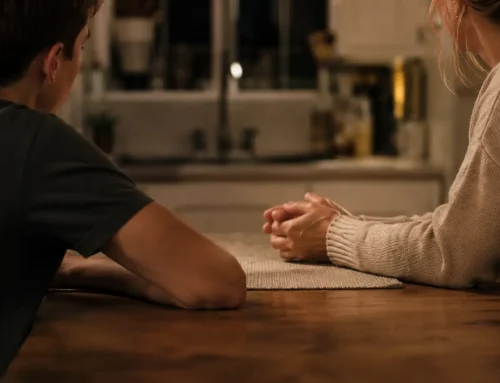
We were talking about our parents. Specifically, about how bad our parents’ marriages were and how hard it had been to grow up inside them. We were both crying by the end of it. And the conclusion we reached together — sitting there in complete agreement, having thoroughly reviewed the available evidence — was that no sane person would ever get married.
Then Dave got down on one knee and asked me to marry him. I said yes.
I want to stay with that a moment, because I told it as a funny story for years and it isn’t one. Or it isn’t only one. Two people looked hard at the best data either of them had on marriage, and the data said don’t, and then they did.
Neither of us had seen it done well. That’s the honest summary, and it’s as much as belongs to me to tell — the two marriages we grew up inside are not mine to narrate, and the people in them are not on trial here.
What I can tell you is what I was handed. In the house I grew up in, nobody said a true thing out loud if a joke would do. Sarcasm was my first language, and I was fluent young. It’s a good language. It’s fast, it’s funny, and it lets you say the thing while keeping the exit open, so that if it lands wrong you were only kidding. Dave was handed a different set of tools, and his weren’t built for saying true things either. We came in fluent in two languages neither of us spoke, both of us certain we were being perfectly clear.
We had no idea what we were doing. What we had instead, across the engagement, was a series of conversations that arrived at one decision: divorce would never be an option. We would not say the D word. Not as a threat, not as leverage, not as the thing you say at the end of a bad night to see what it does to the other person’s face. It was simply gone.
I want to tell you how completely gone. For years afterward I couldn’t say the word in ordinary conversation — about a celebrity, about somebody’s cousin, about people I had never met. I had to whisper it. A grown woman at a lunch table, dropping her voice to say divorce about a stranger. I knew it was ridiculous while I was doing it. I did it anyway.
The decision had gotten into my body before any of the skill did. And I had the sequence backwards for years. I thought the promise was the romantic part and the communication was the work — you fall in love, you make the vow, then you get down to the business of learning to talk to each other, the way you’d pick up a language after moving somewhere. The decision was the easy thing. The competence was the hard thing.
It was the other way around. The decision is what made the competence possible. Every hard conversation we had after that, we had in a room with no exit, and a room with no exit is the only place anybody actually learns anything, because there’s nothing else to do with the problem except understand it.
First year, we finally sat down and admitted we didn’t know how to do this, and we built the only rule we had.
Assume the best intentions.
Neither of us wants to hurt the other. It’s going to happen anyway. When it does, we say it — right or wrong, this is how I’m feeling, based on what I heard or how it landed — and then the other one asks what was going on for the person who lashed out.
I’m not making an argument about who should stay married. Some relationships should end, some should have ended sooner, and I won’t pretend otherwise from inside one that didn’t. My claim is smaller than marriage and much larger.
We are trying to learn to talk to each other — across a marriage, across a town, across a country, across a world that is not sorting itself into fewer camps — without ever deciding we’re staying in the room.
We say the D word about each other constantly now, and at full volume. Cut him off. Done with her. I could never be close to someone who thinks that. The exit isn’t the last resort anymore. It’s the opening move, it’s cheap, and everyone I know reaches for it, on every side of everything.
I reach for it too. Mine is quiet, which is the most respectable kind. I was raised on sarcasm and trained myself into peacemaking, and both are ways of leaving a conversation while staying in the chair.
Over the next twelve weeks I’m going back through what the two of us had to learn after that night, in the order we learned it, which is not the order anyone would have picked. We were building something without a name. It has one now — the Practice of Dialogue, the discipline at the center of the work I do at Human Flourishing. It rests on seven truths we call beams: what truth is, what a mind does when it feels threatened, what disagreement is actually for. One beam a week, starting next week.
But the sequence starts before any of it. The decision comes before the skill.
You can read the next twelve weeks and do nothing about it. Plenty of people will, and it isn’t a lesser way to be here — the beams are worth understanding on their own, and understanding is where this starts. But if someone came to mind while you were reading, and you’ve been managing them instead of talking to them, the decision doesn’t wait for competence. It’s available today, before you know how, which is the only time anybody has ever made it. That’s the One Conversation Challenge. One person. Decide first. Then go.
Stay close to the conversation
We send a weekly digest of new posts community updates, plus essays, and events.
Sign up to stay in the loop.