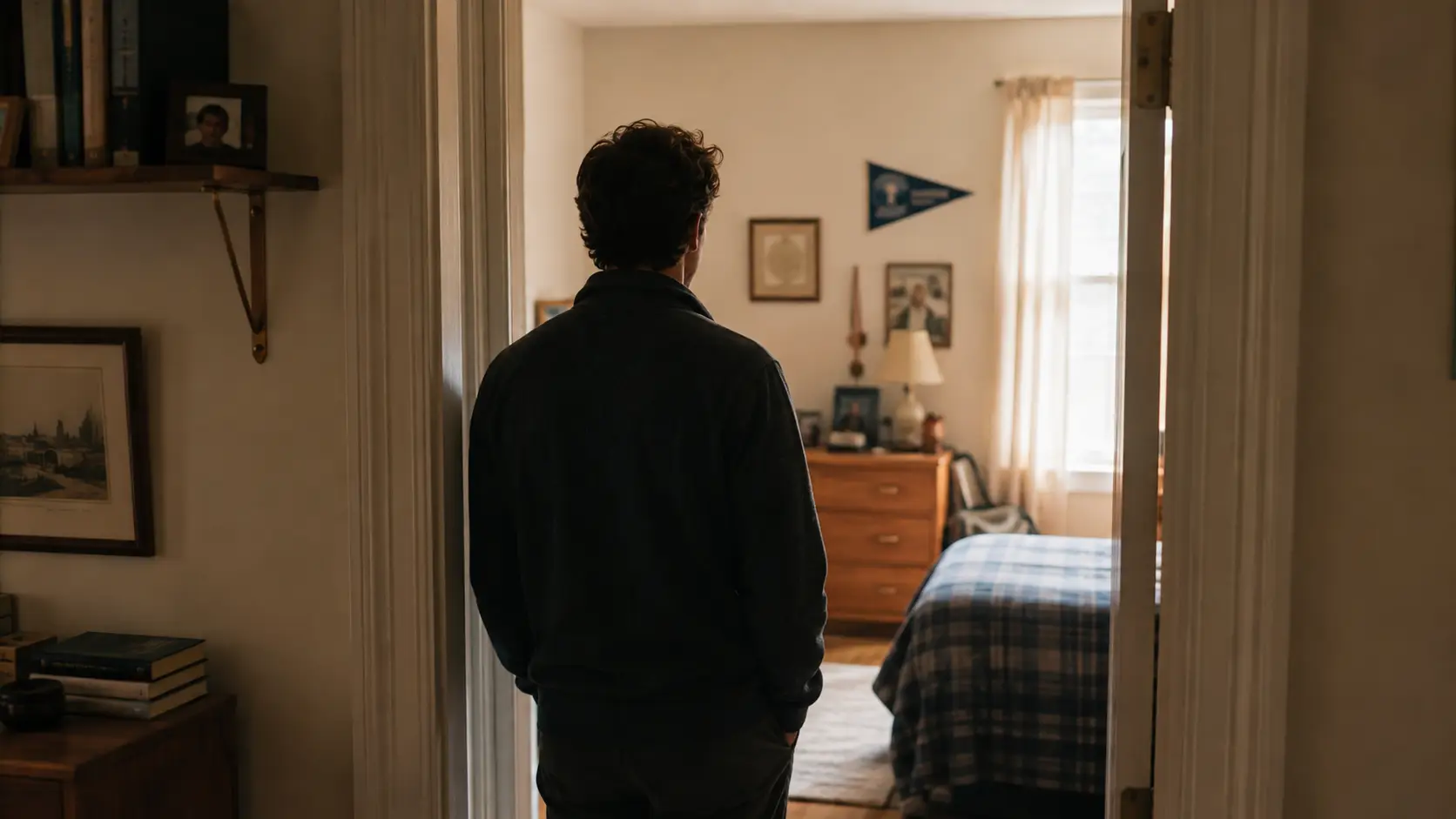
The Sound of What Was Happening
This essay came to life this past Friday evening. I was driving, half-listening to music, when the Buffalo Springfield song came on the radio. It stopped me. The nostalgia hit hard, the good parts of it and the harder parts too, and I felt like I had to write down what I was feeling. Back in 1966 I didn’t understand fear and love the way I do now. Both were real to me then. I just didn’t have the neuroscience to explain what was happening in my own head, or in the country’s.
Join us on October 16th for the Human Flourishing founding launch event, in person or virtual. Details and registration are here: humanflourishing.us/gatherings/founding
I was sixteen in 1966. Buffalo Springfield released a song that December that became the sound of a growing unease, a slow, watchful song about tension in the air, about people squaring off against each other, about the feeling that something was going wrong and nobody could quite name what. It was written about a mood rather than a specific riot or a specific policy. That mood was fear. By 1968 I was in the street myself, protesting a war that felt like it would never end, in a year when it seemed like the country was coming apart.
Four years later, Crosby, Stills, Nash & Young released a much angrier song, written in days, after National Guard troops shot and killed four students at Kent State University during a protest against the invasion of Cambodia. That one was about a fact: four young people were dead, and the country had turned a college campus into a war zone.
I bring these two songs up for more than nostalgia. They remind me how difficult it is to judge the times we’re living through while we’re still inside them.
What 1966–1970 actually felt like
It’s worth remembering what was stacked up in those years, because the songs didn’t come out of nowhere:
- The Vietnam War was escalating, with a draft that could pull any young man out of his life.
- Three of the decade’s most consequential leaders were assassinated in a five-year span: John F. Kennedy in 1963, then Martin Luther King Jr. and Robert F. Kennedy both in 1968.
- Cities burned. Riots followed King’s assassination in over a hundred American cities in a single week.
- The Cuban Missile Crisis, just a few years earlier, had brought the world about as close to nuclear war as it has ever come.
- Campuses were militarized battlegrounds, and by 1970 the National Guard was firing live rounds into a crowd of unarmed students.
That’s the backdrop the Buffalo Springfield song was reacting to before Kent State even happened. And it’s the backdrop that made the Kent State killings feel, to a lot of people my age at the time, like confirmation that everything actually was as bad as it felt.
Why it felt like the worst of times
When you are living through a hard stretch, the fear you feel is not abstract. It is immediate, physical, and loud. It crowds out perspective. I didn’t have the benefit, at sixteen, of having lived through two world wars. The people who had, my parents’ generation and my grandparents’ generation, had seen mobilization on a scale I can barely picture now, rationing, the Holocaust, tens of millions of deaths worldwide. Next to that, 1968 was genuinely brutal. But it was not, by any measure of scale, the worst period in human history. It just felt that way to those of us living inside it, because that’s what fear does. It doesn’t calibrate itself against history. It fills the room you’re standing in.
Fear lives in the present tense. It doesn’t care what came before, and it can make the thing directly in front of you feel like the whole story. Love does the harder work. What we mean by love here is the engaged, problem-solving stance a flourishing mindset runs on, and it asks you to see the problem in front of you and the longer view at the same time.
The longer view
I’m not writing this to talk anyone out of how they feel about today. The feelings are real, and some of the underlying problems are real too. There is still work to do, and that’s not in dispute. But if we’re going to be honest about the problems, we should also be honest about the progress:
- Global extreme poverty has fallen dramatically over the past several decades, from the majority of the world’s population to a small fraction of it.
- Deaths from war and armed conflict, measured per capita globally, are far below where they stood through most of the twentieth century.
- Life expectancy, child mortality, and access to basic healthcare have all improved enormously almost everywhere on earth, including in the poorest countries.
- More people today have the time, income, and freedom to do the very things that define a flourishing life: invent, create, organize, protest, and build things that didn’t exist before. When I marched in 1968 I was exercising something a great many people in the world still did not have. More of them have it now.
None of that erases a single hard thing happening right now. It just means the hard things happening right now are not, by themselves, evidence that the world is on a downward slope.
Looking back without romanticizing it
There’s a temptation to look at the 1960s the way people sometimes look at any earlier era: as a golden age we’ve since fallen from. Anyone who was actually there singing along to Buffalo Springfield in the street, or watching the news after Kent State, can tell you that’s not quite right. The sixties were an extraordinary time to be alive: the music, the energy, the sense that culture itself was being rewritten in real time. They were also a time of assassination, war, riot, and a government firing on its own citizens. Both things are true.
We remember our own pain more vividly than we remember anyone else’s, and we remember the past’s pain less vividly than we remember the past’s music. No wonder the past can look better from here than it ever felt while we were living it.
If there’s a single thing worth carrying forward from those two songs, it’s the reminder that the fear in the air during a hard stretch always feels like the whole picture, and it never is. We will do better work if we can face what’s wrong without allowing fear to convince us that nothing is getting better. The problems in front of us are real. So is the fact that we’re better equipped, healthier, and more prosperous than any generation that came before us to actually solve them.
Don’t let fear and pessimism set the terms of how you see the world.
Scott McIntosh, Chairman / CEO Human Flourishing
30 August 2026
Join us on October 16th, in person or virtual, and be part of a movement making the case for rational optimism, one honest conversation at a time. You can make a difference. Register here: humanflourishing.us/gatherings/founding

Stay close to the conversation
We send a weekly digest of new posts community updates, plus essays, and events.
Sign up to stay in the loop.